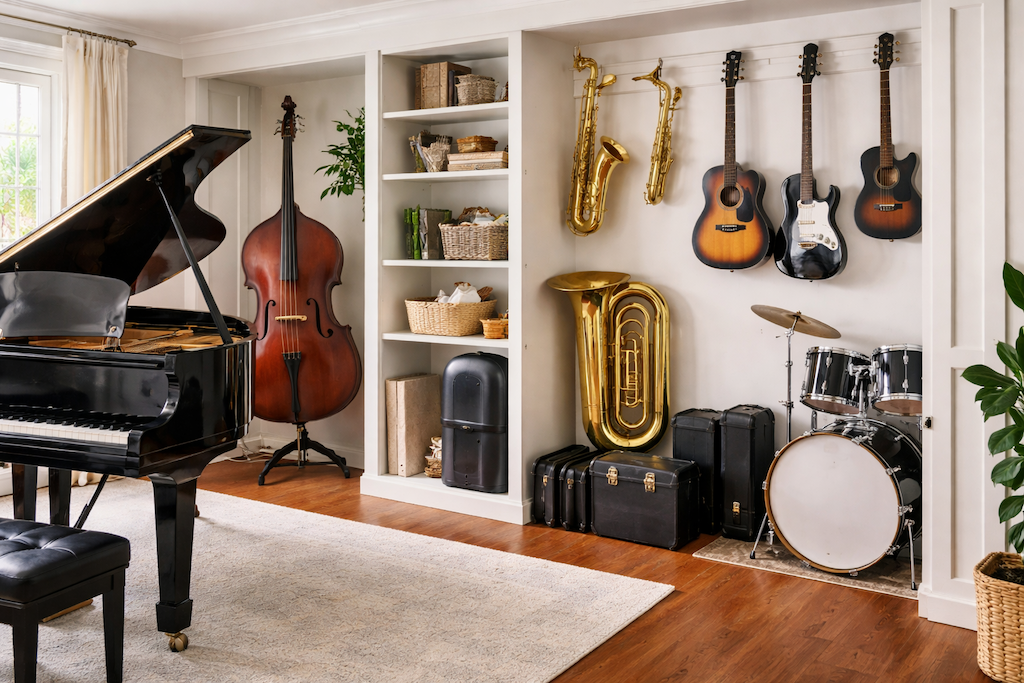
Every home needs harmony and fun, but getting rid of heavy equipment would probably be the hardest job ever. A challenging job for any homeowner is to put all these instruments away and find an empty place in the house, be it a piano, a cello, a double bass, or a drum kit.
The homeowners have a confusion, while they arrange their lives in clean aesthetics, they still consider enjoying music. Smart ways are there to plan and manipulate spaces, even big instruments could find their magic way into the home without looking out of place.
If you were to do home remodeling in Houston, Texas, these tips will help you design your settings in function and fashion while accommodating your musical taste.
1. Choose the Right Room
Select a room that bears relatively constant temperature and humidity. The piano and cello, among other instruments, are large wooden stringed instruments with the potential to warp or crack on exposure to changes in weather. It has to be a room free from heating vents and direct sunlight or windows. For example, if you are remodeling your Texas home, consider built-ins or a climate-controlled area for your instruments. It gives safety to the music gears and fits well into the design of your home.
2. Use Vertical Space
Storage vertically makes a sheer difference when the space is limited. For example, these wall-mounted racks, hooks, or simply shelves can store a lot of musical instruments like guitars, violins, or even mini percussion setups directly on the walls. Anything bigger, like a double bass, can be ideally put in place by some custom wall fitting so that the floor stays clear to allow walking about or putting other furniture. Generally ignored, smart use of vertical space forms one of the best tips in reducing clutter and maximizing easy-to-reach access to your instruments.
3. Consider Custom Cases and Covers
Soft and hard cases are essential not only for transport but also for storage. They are the only sure methods of protecting against accidental knocks; soft cases prevent dust and scratches, but not the worst bumps. They should all carry their labels, which is even more necessary when there are several instruments; then it’s just so easy for the retrieval process to take place.
Storage corners, cubbyholes, or closets built around instrument cases in a home model would really make a difference to a person undergoing home remodeling in Houston, Texas, and also make the home more appealing.
4. Multi-Purpose Furniture
The music lover may prefer furniture that serves as storage. For instance, benches can be designed to store sheet music, while cabinets can store small instruments alongside large ones, like drumsticks or metronomes. More importantly, they simply provide a less cluttered room. If you are renovating, built-in benches or cabinets would enhance acoustics as well as aesthetics in the room. Your instruments will be safe and organized, as opposed to becoming an eyesore in the house, but rather part of your home’s decor.
5. Create a Music Corner
The term “music corner” means more than just keeping your belongings in order; it kindles creativity. Having a soft sofa with some snazzy lights in the corner where one can quickly get to their instruments will surely encourage practice. To this end, while you are choosing home remodeling, you would exclude the music corner from the remodeling efforts, on purpose creating distance from busy, noisier areas in the house so that it might exist in peace with your other family and friends as well as neighbors.
Conclusion
While housing large musical instruments at home may pose challenges, with some external considerations, a little creativity, and protective accessories, you can keep your instruments safely organized for easy access whenever needed. Be it renovation for a previous or a home remodeling, adding storage solutions for your instruments will enhance the practicality of the said space and look great doing it. After all, your home should be a respite for living and making music.